Hands Behind HeadPose Reference
Camera angles
Standing Hands Behind Head opens both elbows above a tilted waist, giving the wooden figure a broad upper shape and offset footing.
Tags: standingfigure drawingfull bodyhands behind head
How to draw the Hands Behind Head pose
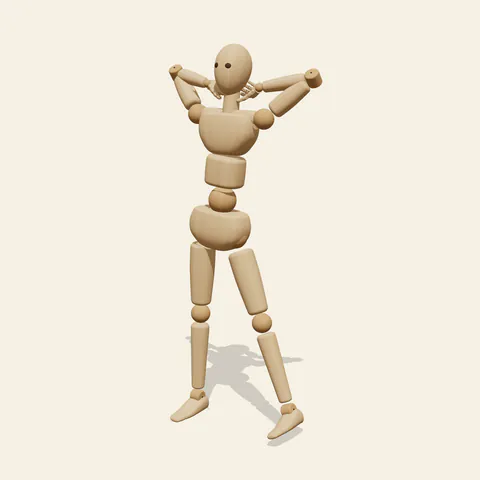
three-quarter view 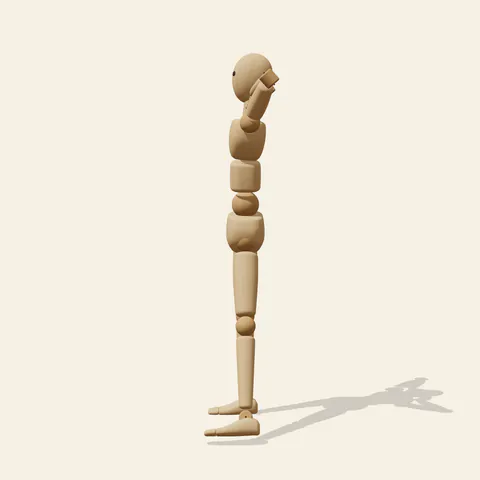
side view 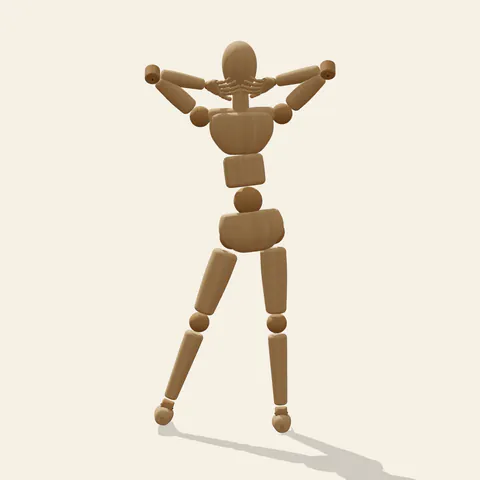
back view 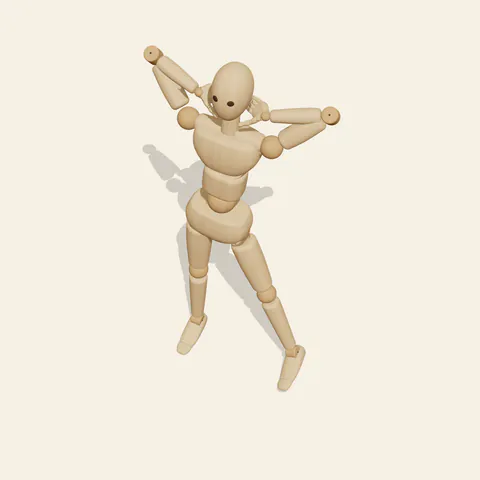
high-angle view
With both forearms returning toward the head, the elbows establish the widest part of the upper silhouette. The legs do not mirror that symmetry: one remains comparatively upright while the other reaches diagonally outward. A slight hip displacement connects this uneven base to the lifted chest. Read the stance as an arrangement of broad and narrow regions, moving from elbows to waist to feet. The blank space under each upper arm should remain distinct, even though both hands occupy a similar area behind the skull and are partly concealed from the front.
When drawing, lightly connect the shoulder centers before adding the upper arms. This keeps one elbow from seeming to grow out of the neck. A three quarter angle exposes the return path of a forearm that a straight frontal view may hide. Profile studies are useful for checking whether the head is supported between the hands or merely pushed forward ahead of the chest. The wooden mannequin has simplified wrists and palms, so use their placement to understand the large gesture rather than reading invisible fingers into the back of the head. The outward leg should still connect convincingly to its own hip socket.
More on angles and common mistakes
The easiest mistake is to make both knees equally bent and accidentally turn the pose into a squat. Another is to flatten the pelvis until the asymmetric stance loses its purpose. This reference fits relaxed waiting scenes, confident portrait planning and exercises comparing bilateral arms with uneven legs. Select Edit this pose and bring the extended foot a little closer to the standing foot, leaving the arms unchanged. The same upper gesture will then feel more contained. Check the weight line after moving the foot, and adjust the pelvis only enough to preserve a plausible upright balance rather than automatically centering the entire figure.
Free to use (CC0). The pose images on this page are released under CC0 1.0 (public domain dedication). Use them for drawing practice, commercial illustration, reference sheets or AI image generation; no attribution is required. A credit to PoseMaker is appreciated but optional.
Hands Behind Head pose prompt
Copy a prompt for your AI image generator. Pair it with the OpenPose skeleton in ControlNet so the generated character matches this exact pose.
General prompt
A person stands with both hands behind the head and elbows spreading widely. One leg supports the shifted hips while the other extends diagonally sideways. Show a relaxed chest, forward-facing head, complete feet and a simple empty backdrop.
Midjourney
full body standing person, hands behind head, broad outward elbows, lifted chest, asymmetric hips, one leg angled out, other leg nearly vertical, calm forward gaze, neutral studio backdrop --ar 2:3 --style raw
Stable Diffusion
1person, full body, hands behind head, elbows out, standing, asymmetric stance, extended side leg, shifted weight, open chest, bent arms, front three quarter view, forward gaze, visible feet, relaxed gesture, plain background, balanced proportions, clear arm gaps
Negative prompt
hands on crown, narrow tucked elbows, symmetrical squat, both knees deeply bent, detached forearms, head through wrists, extra legs, missing elbows, fused hands, twisted ankles, cropped feet, noisy background
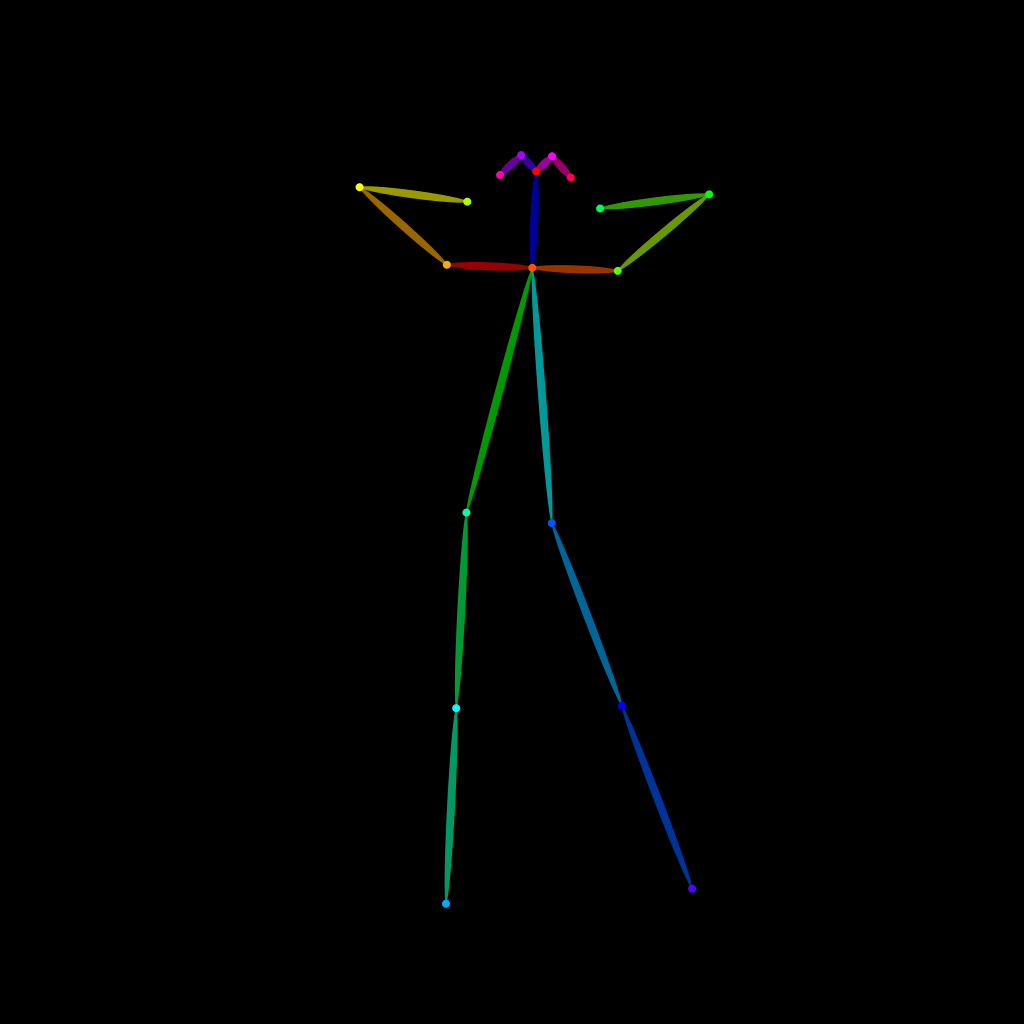
OpenPose skeleton for ControlNet
Load the PNG into a ControlNet OpenPose unit (preprocessor: none), or import the JSON into an OpenPose editor.
Have a photo of the pose you want?
Upload it to Photo to Pose. We detect the pose in your browser and put it on the mannequin, ready to adjust.