Lying, Knees to SidePose Reference
Camera angles
Lying, Knees to Side is a gentle supine twist: the shoulders stay flat, the arms rest overhead palms up, and both bent knees drop together to one side.
Tags: lyingon backsupine twistarms overheadfull body
How to draw the Lying, Knees to Side pose
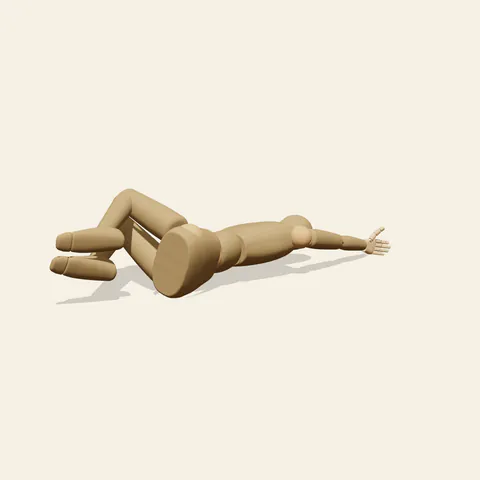
three-quarter view 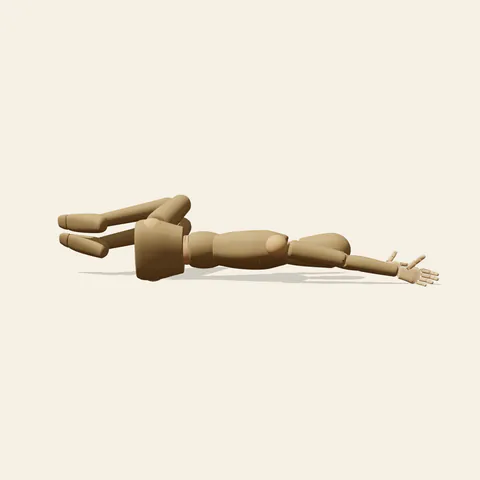
side view 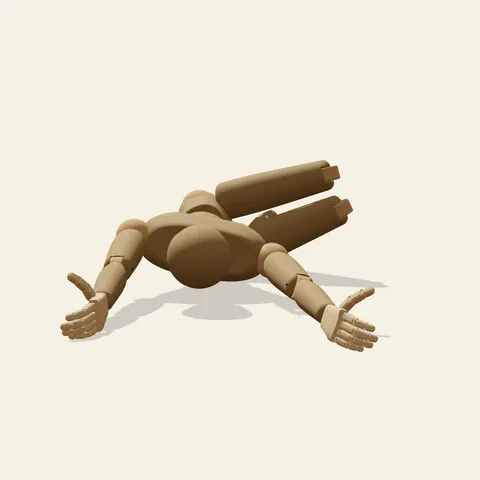
back view 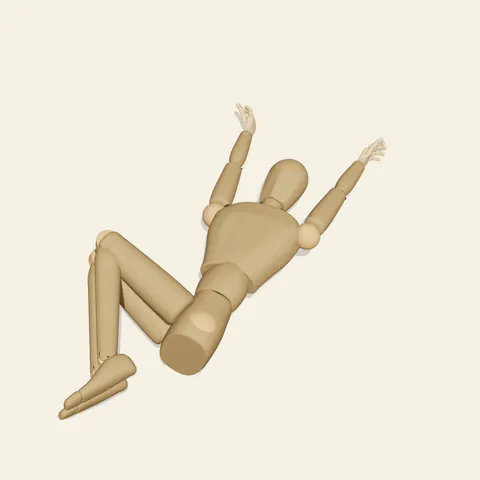
high-angle view
Two levels of the body move in different planes. The upper body stays square to the floor, with both arms stretched overhead and the backs of the hands resting down so the palms face up. Below the waist the pelvis rolls onto its side and the legs follow as one unit, knees bent and stacked, feet close together. The rotation spreads through the lower ribs and waist, so the navel faces somewhere between the ceiling and the side wall. No muscle holds anything up: the head sits at 13 cm and the centre of mass at only 14 cm, a fully grounded resting shape.
The high angle is the most readable view because it shows the flat shoulders while the legs fold away in a clear zigzag. In the side view from the figure's left, the long torso and arms run flat and the folded knees bunch at the near end. Looking from the feet, the front view is dominated by the pelvis and stacked thighs, which hide most of the torso. Mind the overlap: the top thigh lies across the bottom one, and the top foot rests on or just behind the lower foot.
More on angles and common mistakes
Rotating the shoulders along with the hips is the main mistake, since it turns the supine twist pose into ordinary side-lying. Separated knees, straightened legs and a pelvis left flat while only the knees tip over are the others; the last one twists the knee joints instead of the spine. The pose fits cool-down pages in yoga illustration, bedtime and rest scenes, a figure relaxing on imagined grass, and gesture studies that contrast a flat ribcage with a rotated pelvis.
Choose Edit this pose and turn the head away from the knees to deepen the counter-rotation, or open one arm out at shoulder height for the T-shaped version many teachers use. Rolling the pelvis a few degrees back toward the ceiling gives a softer twist for a beginner.
Free to use (CC0). The pose images on this page are released under CC0 1.0 (public domain dedication). Use them for drawing practice, commercial illustration, reference sheets or AI image generation; no attribution is required. A credit to PoseMaker is appreciated but optional.
Lying, Knees to Side pose prompt
Copy a prompt for your AI image generator. Pair it with the OpenPose skeleton in ControlNet so the generated character matches this exact pose.
General prompt
A person lying on their back in a gentle supine twist, both arms stretched overhead on the floor with palms up and shoulders flat. The knees are bent and held together, and both legs drop to one side so the hips roll. Relaxed face, high angle view, plain background.
Midjourney
full body person lying on back, supine twist, arms stretched overhead, palms up, shoulders flat on the floor, bent knees together dropped to one side, relaxed yoga cool-down, high angle view, plain background --ar 3:2 --style raw
Stable Diffusion
1person, full body, lying on back, supine twist, yoga, arms overhead, palms up, shoulders flat, knees bent, knees together, legs to one side, hip rotation, relaxed, stretching, from above, high angle, plain background
Negative prompt
lifted shoulders, side lying, knees apart, straight legs, arms at sides, hips flat, sitting up, extra legs, extra arms, fused fingers, twisted neck, distorted torso, cropped feet, blurry, nsfw
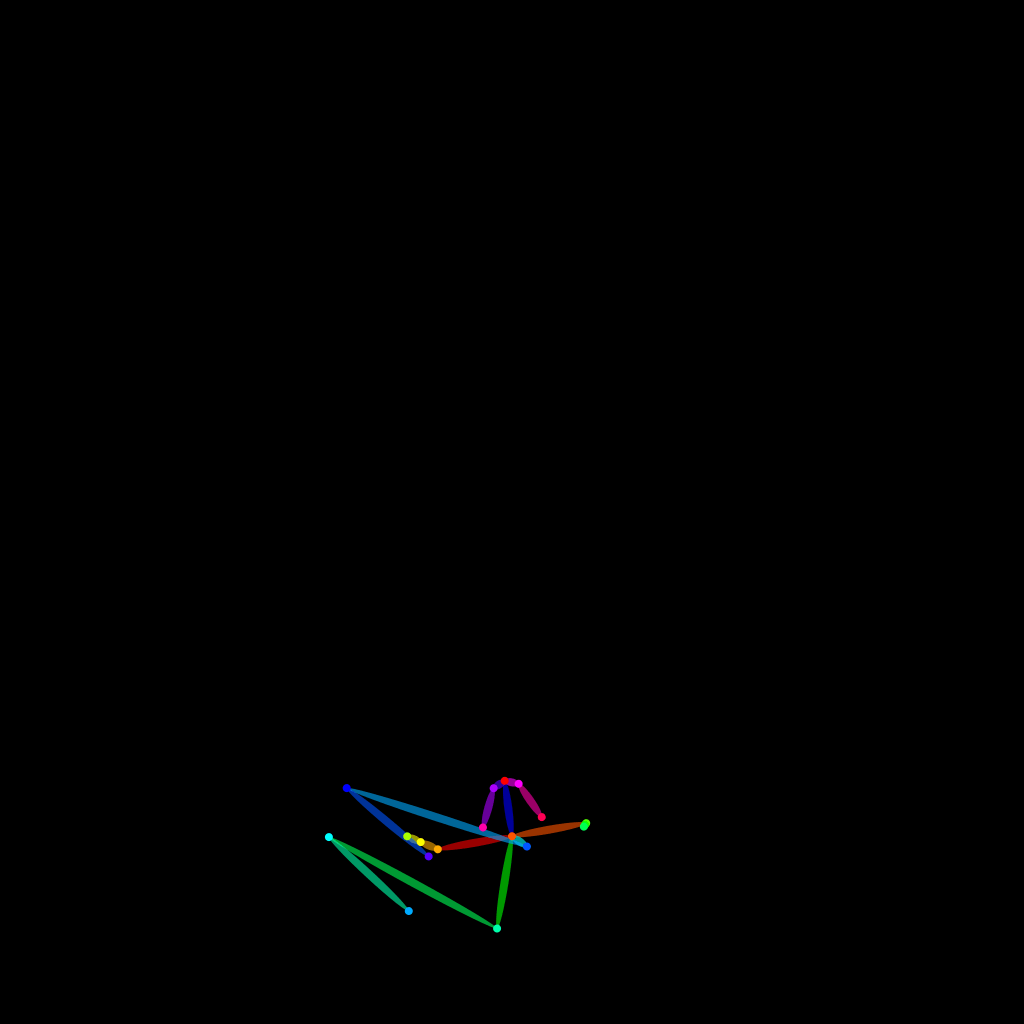
OpenPose skeleton for ControlNet
Load the PNG into a ControlNet OpenPose unit (preprocessor: none), or import the JSON into an OpenPose editor.
Have a photo of the pose you want?
Upload it to Photo to Pose. We detect the pose in your browser and put it on the mannequin, ready to adjust.